Guide
How to Make a Wedding Budget (2026)
Making a wedding budget is the single most useful hour you will spend planning. Do it first — before you book anything — and every later decision gets easier. Here is a clear, five-step way to build one in 2026.
Step 1 — Set your total number first
Add up what you can realistically spend: your savings earmarked for the wedding, any family contributions (ask early and get specifics), and what you can save between now and the date. That total is your ceiling. For context, the average US wedding costs about $34,000 in 2026, but the right number is the one you can afford without debt.
Step 2 — Split it by category
Use standard percentages as a starting point: venue & catering ~45%, photography ~12%, attire ~8%, flowers ~8%, music ~7%, and the rest across cake, stationery, rings and extras. Then adjust to your priorities — shift a few points toward whatever matters most to you.
Step 3 — Keep a buffer
Set aside 5–8% as contingency and do not touch it. Almost every wedding turns up a cost you did not plan for — overtime, alterations, a weather backup. The buffer is what keeps a surprise from becoming a crisis.
Step 4 — Track estimated vs actual, with deposits
As you book, record each vendor's quote, the deposit you paid and the balance you still owe. Comparing estimated against actual is how you catch overspending while you can still fix it — not after.
Step 5 — Watch the ‘remaining’ number
The one figure to keep your eye on is what is left: total minus committed. If it goes red, you adjust the next decision, not the last one. Couples who watch a live remaining figure overspend far less than couples guessing.
You can do steps 1–2 right now in our free wedding budget calculator — set your number and it splits it into categories instantly.
Build my wedding budget free →
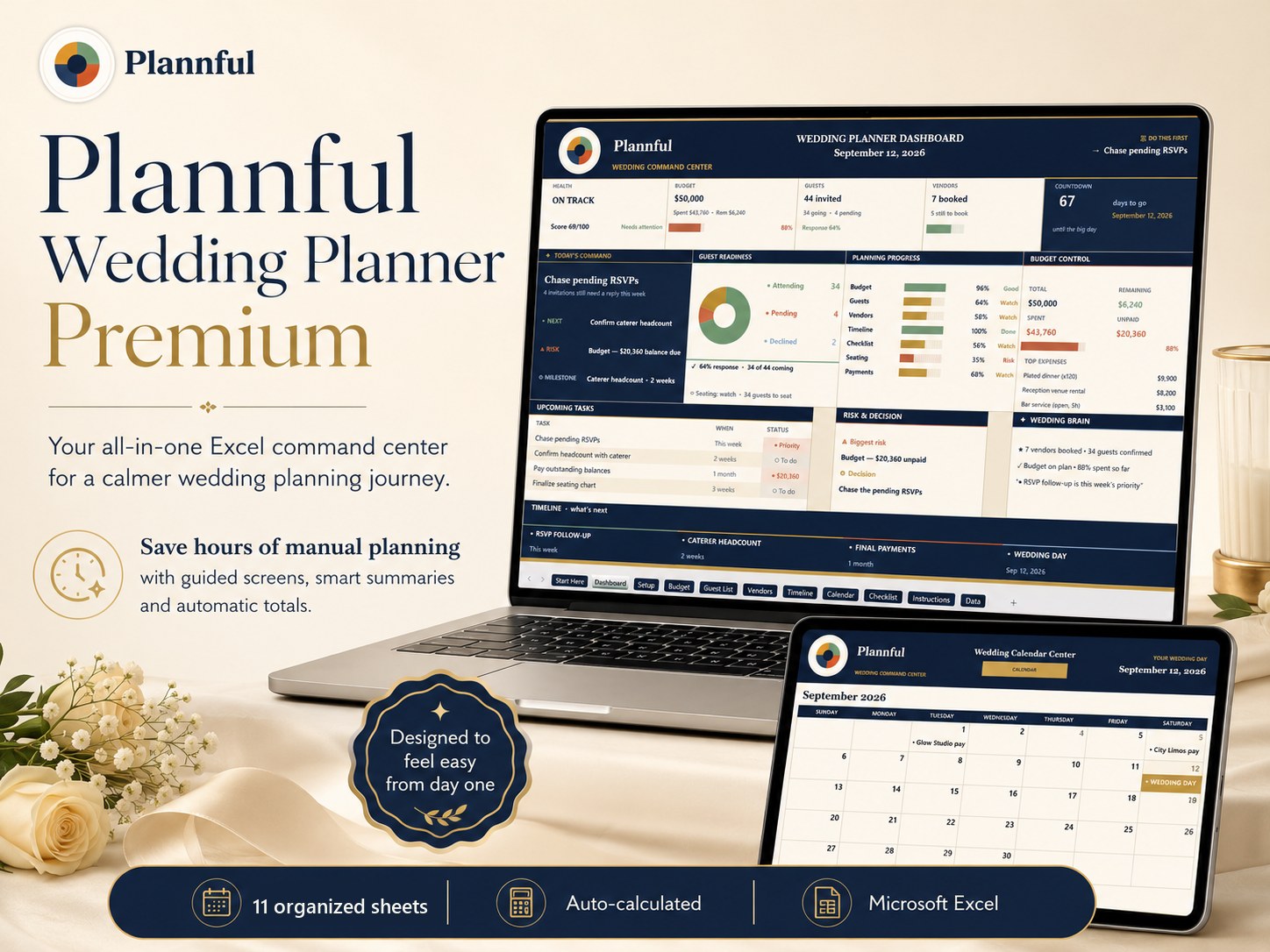
For steps 3–5 — deposits, balances and a live remaining figure that tracks every vendor — the Plannful Wedding Planner does it all in Microsoft Excel, alongside your guest list and timeline.
Ready to organize the whole wedding? See the Microsoft Excel Wedding Planner — one Microsoft Excel workbook for budget, guest list, vendors, timeline, calendar and checklist.
Frequently asked questions
How do I start a wedding budget?
What percentage of a wedding budget goes to each thing?
How much should I keep as a wedding budget buffer?
Sources and methodology
The national figures on this page come from the study below. Any example budgets, category splits or worked calculations are Plannful’s own, based on the example budget used in this guide, and are presented as such — not as national data.
- The Knot 2026 Real Weddings Study — Self-reported survey of 10,474 US couples married between 1 January and 31 December 2025. (The Knot Worldwide)
Planning your whole wedding?
Keep every part of your wedding — budget, guest list, vendors and timeline — organized in one Microsoft Excel workbook.
Plannful Wedding Planner for Microsoft Excel
- Budget Tracker
- Guest List
- Vendor Tracker
- Wedding Timeline
- Planning Calendar
- Checklist
Related guides & free tools
- Wedding Guest List Template (2026)What a great wedding guest list template tracks in 2026 — RSVPs, meal choices, plus-ones,
- How to Make a Wedding Seating Chart (2026)How to make a wedding seating chart in 2026 — when to start, how many per table, a simple
- Wedding Planning Checklist & Timeline (2026)A month-by-month wedding planning checklist and timeline for 2026 — what to do 12 months o
- Average Wedding Cost by US State in 2026: A State-by-State BreakdownThe average US wedding cost $33,000 in 2026, but ranges from $15,000 in Utah to $55,000 in
- Who Pays for the Wedding? Traditional vs Modern Splits in 2026Traditional etiquette vs the 2026 reality: couples now pay ~50% of wedding costs, the brid
- How to Break Down a $50,000 Wedding Budget in 2026A $50,000 wedding budget in 2026 covers 120-150 guests: $15,000 venue, $10,000 catering, $
- Free Wedding Budget CalculatorFree tool · no signup
- Wedding Cost Estimator by Guest CountFree tool · no signup
Free cheat sheet
Get the 1-page wedding budget cheat sheet
Join the Plannful list for a simple breakdown of how to split your wedding budget by guest count — plus the occasional template discount. No spam, unsubscribe anytime.