Guide
Who Pays for the Wedding? Traditional vs Modern Splits in 2026
The short answer in 2026: there is no single rule anymore, but the data is clear — couples now cover roughly 47–50% of their own wedding costs, while the bride's family pays about 23% and the groom's family roughly 8–10%. The traditional etiquette playbook still exists, but fewer than 1 in 5 weddings actually follow it to the letter. Here is how the old split worked, what really happens today, and how to plan your own budget without awkward surprises.
The traditional etiquette split
Classic American wedding etiquette assigned costs by family, and for more than a century the breakdown was remarkably consistent. The model assumed the bride moved straight from her parents' home into marriage, which is why her family acted as the "host" and shouldered most of the bill.
- The bride's family paid the largest share — the ceremony, the reception venue, catering, flowers, photography, invitations, and the bride's dress. Historically this was 50% or more of the total.
- The groom's family covered the rehearsal dinner, the officiant's fee, the marriage license, and often the honeymoon — usually 10–15% of costs.
- The couple traditionally paid for very little: the wedding rings for each other and small gifts for the wedding party.
With the average marrying age now near 32 for men and 30 for women, that "moving out of the family home" assumption rarely holds. Most couples have lived independently for years and earn their own incomes, so the etiquette that made sense in 1960 feels dated in 2026.
The modern reality in 2026
Today the money follows whoever can pay, not tradition. Industry surveys put the average US wedding at roughly $33,000–$35,000 in 2026. On average:
- The couple pays about 47–50% — close to $16,000 out of pocket. Many couples are older, employed, and prefer control over the guest list and style.
- The bride's parents contribute about $11,000 on average (around 23% of the total).
- The groom's parents contribute about $4,000 on average (8–10%).
- Other relatives and the wedding party cover the remaining slice, including showers and bachelor or bachelorette trips.
Same-sex couples and blended families have accelerated the shift — there is no "bride's side" default, so most simply split by who is willing and able. Roughly 90% of couples still receive some family money, but it increasingly arrives as a lump sum or a single category rather than the old line-by-line obligation. The healthiest approach in 2026 is a direct conversation: ask each set of parents for a fixed dollar amount or a specific category, then build the rest around what you can fund yourselves. Pooling everything into one tracked budget avoids the most common fight, which is two parties unknowingly spending the same dollars.
It also helps to agree on what a contribution does and does not buy. A parent funding 30% of the venue may expect a say in the guest count, so naming the number and the strings attached up front prevents resentment later. Treat the split as a negotiation, not an entitlement, and put the result in writing.
Who traditionally pays for what
Use this as a starting point for the money conversation, not a rulebook. Modern couples reassign these lines freely, and the costs below reflect typical 2026 US averages.
| Wedding expense | Who traditionally pays | Typical 2026 cost |
|---|---|---|
| Ceremony & reception venue | Bride's family | $12,000 |
| Catering & bar | Bride's family | $8,000 |
| Photography & video | Bride's family | $3,500 |
| Flowers & decor | Bride's family | $2,500 |
| Rehearsal dinner | Groom's family | $2,000 |
| Officiant & marriage license | Groom's family | $350 |
| Honeymoon | Groom's family (now usually couple) | $5,000 |
| Wedding rings | The couple | $1,800 |
| Wedding party gifts | The couple | $500 |
How to plan your split without the stress
Whatever the percentages, every contributor needs to see the same numbers. Start by setting a hard ceiling, then assign each category an owner and a dollar cap. Our wedding budget spreadsheet templates let you tag each line with who pays, track deposits versus balances, and flag overspending before it happens. If you want to model a few scenarios first — for example, what happens if the groom's parents cover the bar instead of the honeymoon — run the numbers through our free wedding budget calculator in a couple of minutes.
The goal is one source of truth that every family member can read. Lock in fixed contributions early, keep a running balance, and revisit it monthly so nobody is surprised by a deposit deadline. Couples who track their split this way report far fewer money arguments and rarely blow past their ceiling by more than 5%. You can find our full library of planners and trackers in our Etsy shop, all built to keep contributions, deposits, and final costs in one clean view straight through your 2026 wedding day. Whoever ends up paying, a shared spreadsheet turns an awkward family topic into a simple, transparent plan.
Plan the whole wedding in one place
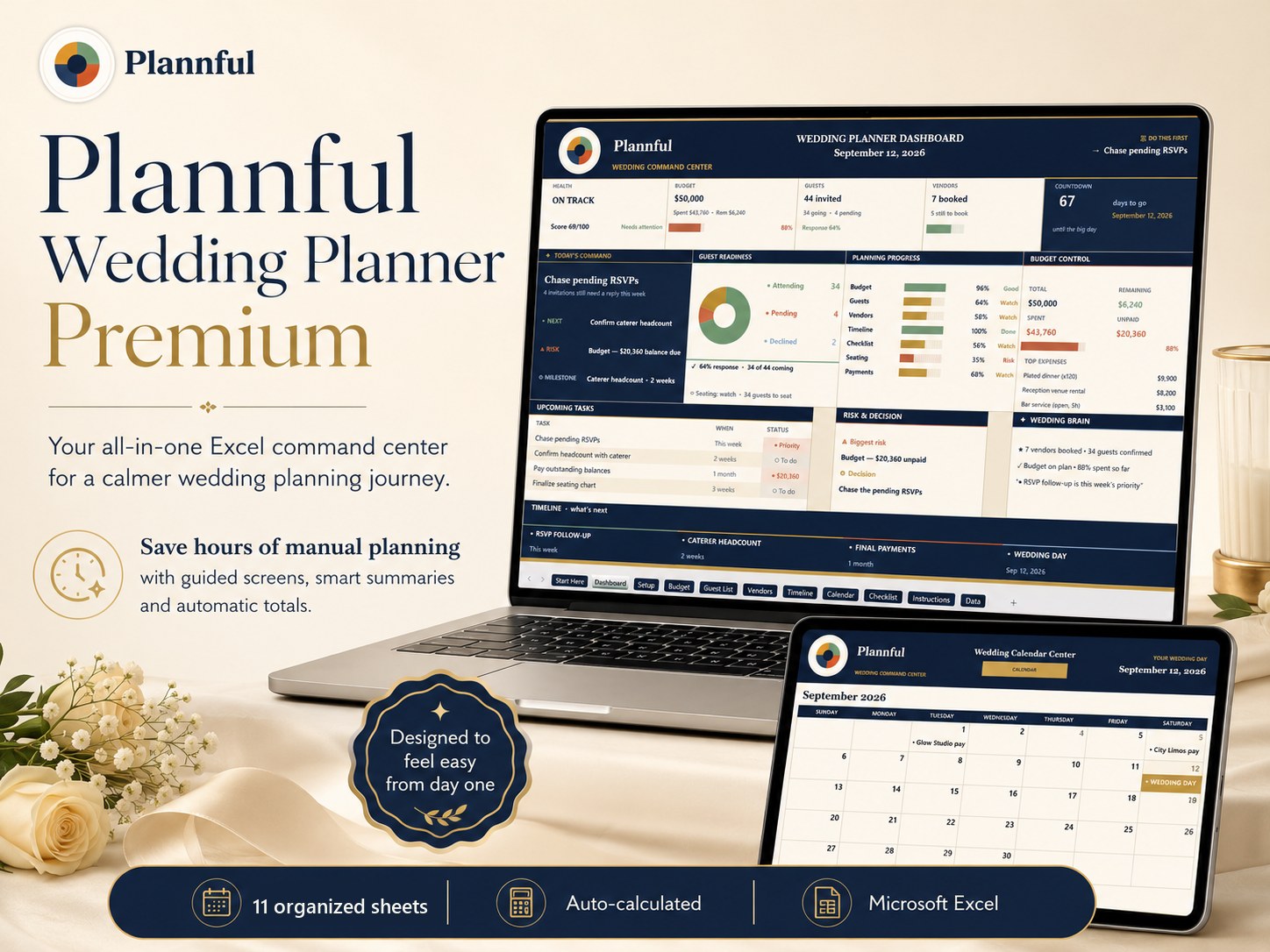
The Plannful Wedding Planner Premium for Microsoft Excel does the budget, guest list, timeline, calendar and checklist math for you — 10 organized working screens, real formulas, instant download.
See the Wedding Planner →Frequently asked questions
Who pays for the wedding in 2026?
What does the groom's family traditionally pay for?
How much do parents contribute to a wedding on average?
Is it rude to ask parents to pay for the wedding?
Planning your whole wedding?
Keep every part of your wedding — budget, guest list, vendors and timeline — organized in one Microsoft Excel workbook.
Plannful Wedding Planner for Microsoft Excel
- Budget Tracker
- Guest List
- Vendor Tracker
- Wedding Timeline
- Planning Calendar
- Checklist
Related guides & free tools
- How to Break Down a $50,000 Wedding Budget in 2026A $50,000 wedding budget in 2026 covers 120-150 guests: $15,000 venue, $10,000 catering, $
- How to Plan a Wedding on a $15,000 Budget in 2026Plan a beautiful $15,000 wedding in 2026: a full category breakdown for 50–75 guests
- Wedding Day Timeline: A Sample Hour-by-Hour Schedule for 2026Plan the perfect day with our hour-by-hour wedding day timeline for 2026. Get a ready-to-c
- Questions to Ask Wedding Vendors Before Booking in 2026The must-ask questions to ask wedding vendors in 2026, organized by type. Spot hidden fees
- How Much to Tip Wedding Vendors in 2026: The Complete Gratuity GuideThe headline rule for 2026: budget roughly 2−3% of your total wedding cost for tips.
- Wedding Budget for 100 Guests in 2026: The Real NumbersA 100-guest wedding in 2026 costs about $300 per guest, or roughly $30,000 total. See the
- Free Wedding Budget CalculatorFree tool · no signup
- Wedding Cost Estimator by Guest CountFree tool · no signup
Free cheat sheet
Get the 1-page wedding budget cheat sheet
Join the Plannful list for a simple breakdown of how to split your wedding budget by guest count — plus the occasional template discount. No spam, unsubscribe anytime.