Guide
How to Break Down a $50,000 Wedding Budget in 2026
A $50,000 wedding budget in 2026 comfortably covers a celebration for 120−150 guests with mid-to-premium vendors. The single biggest line is your venue at roughly $15,000 (30%), followed by catering at $10,000 (20%). Below is the exact dollar-and-percent split that keeps a $50k wedding on track without surprises.
The $50,000 wedding budget breakdown
Every category below is expressed as both a percentage and a hard 2026 dollar figure. The amounts sum to exactly $50,000 and the percentages sum to 100%. Treat these nine rows as starting targets, then shift money between them based on what matters most to you as a couple.
| Category | Percentage | Amount (2026) |
|---|---|---|
| Venue & rentals | 30% | $15,000 |
| Catering & bar | 20% | $10,000 |
| Photography & video | 12% | $6,000 |
| Flowers & decor | 10% | $5,000 |
| Attire & beauty | 8% | $4,000 |
| Music & entertainment | 7% | $3,500 |
| Buffer (contingency) | 5% | $2,500 |
| Stationery & signage | 4% | $2,000 |
| Miscellaneous | 4% | $2,000 |
| Total | 100% | $50,000 |
What a $50,000 budget actually buys in 2026
At this level you are firmly in the mid-to-premium tier. With catering at $10,000 and a guest count of 120−150, your per-head food & bar spend lands between $67 and $83 − enough for a plated dinner or a generous station-style buffet with an open bar in most US markets. The $15,000 venue figure secures a well-reviewed barn, vineyard, or boutique hotel on a Saturday in shoulder season; peak summer Saturdays in major metros can push that same space higher, which is exactly why the buffer exists.
Photography at $6,000 hires an established photographer with 8 hours of coverage plus a second shooter, and often a short highlight film. Flowers and decor at $5,000 supports a full bridal party, a ceremony installation, and centerpieces for 12−15 tables. Attire and beauty at $4,000 covers the dress, alterations, the suit, and hair-and-makeup for the couple plus a few attendants. Music at $3,500 books a strong DJ or a small live band for a 4−5 hour reception.
The smaller rows still add up. Stationery and signage at $2,000 pays for save-the-dates, invitations, menus, escort cards, and welcome signage for roughly 80−100 invitations. The $2,000 miscellaneous line catches officiant fees, transportation, favors, and the dozens of $50−$150 items that appear in the final month.
How to adjust the numbers
No two weddings split $50,000 the same way. Use these levers to personalize the plan without breaking the total:
- Cut the guest list. Dropping from 150 to 120 guests frees roughly $2,000−$2,500 in catering you can move to photography or flowers.
- Pick an off-peak date. A Friday, Sunday, or November wedding can shave 15−25% off the $15,000 venue line.
- Reallocate, do not overspend. If music matters more than paper, move $1,000 from the $2,000 stationery row into the $3,500 entertainment row − the total stays at $50,000.
- Go digital where you can. Online RSVPs and a wedding website can trim the $2,000 stationery line by $400−$600.
- Track every deposit. Vendors in 2026 typically take 25−50% upfront, so map payment dates against your timeline from day one.
Why the 5% buffer is non-negotiable
That $2,500 buffer (5%) is the difference between a calm planning year and a stressful one. It absorbs sales tax (often 6−9%), vendor gratuities, overtime, delivery and setup fees, and the inevitable "we forgot about that" costs − marriage-license fees, welcome bags, alterations round two, and day-of emergency kits. Couples who skip the buffer almost always blow past $50,000; couples who protect it usually finish at or under budget. If you reach your wedding month with the buffer untouched, roll it into an upgrade or simply keep it.
One more rule of thumb for 2026: prioritize the three lines your guests remember most − the venue atmosphere, the food and drink, and the photos. Together those account for $31,000, or 62% of the $50,000, and protecting them is the safest way to feel the money was well spent.
Tools to keep your $50k on track
Plug these figures into our wedding budget spreadsheet templates, which auto-calculate category totals, deposits paid, and your remaining balance as you book each vendor. If you want a fast estimate before committing, run your numbers through the free wedding budget calculator first. You can also find printable and editable planners in our Etsy shop. Start with the table above, lock in your venue and catering, hold the 5% buffer firmly, and a $50,000 wedding in 2026 stays exactly that − $50,000. If that total feels tight, the guest count is the lever: about half of a wedding budget scales directly with heads.
Plan the whole wedding in one place
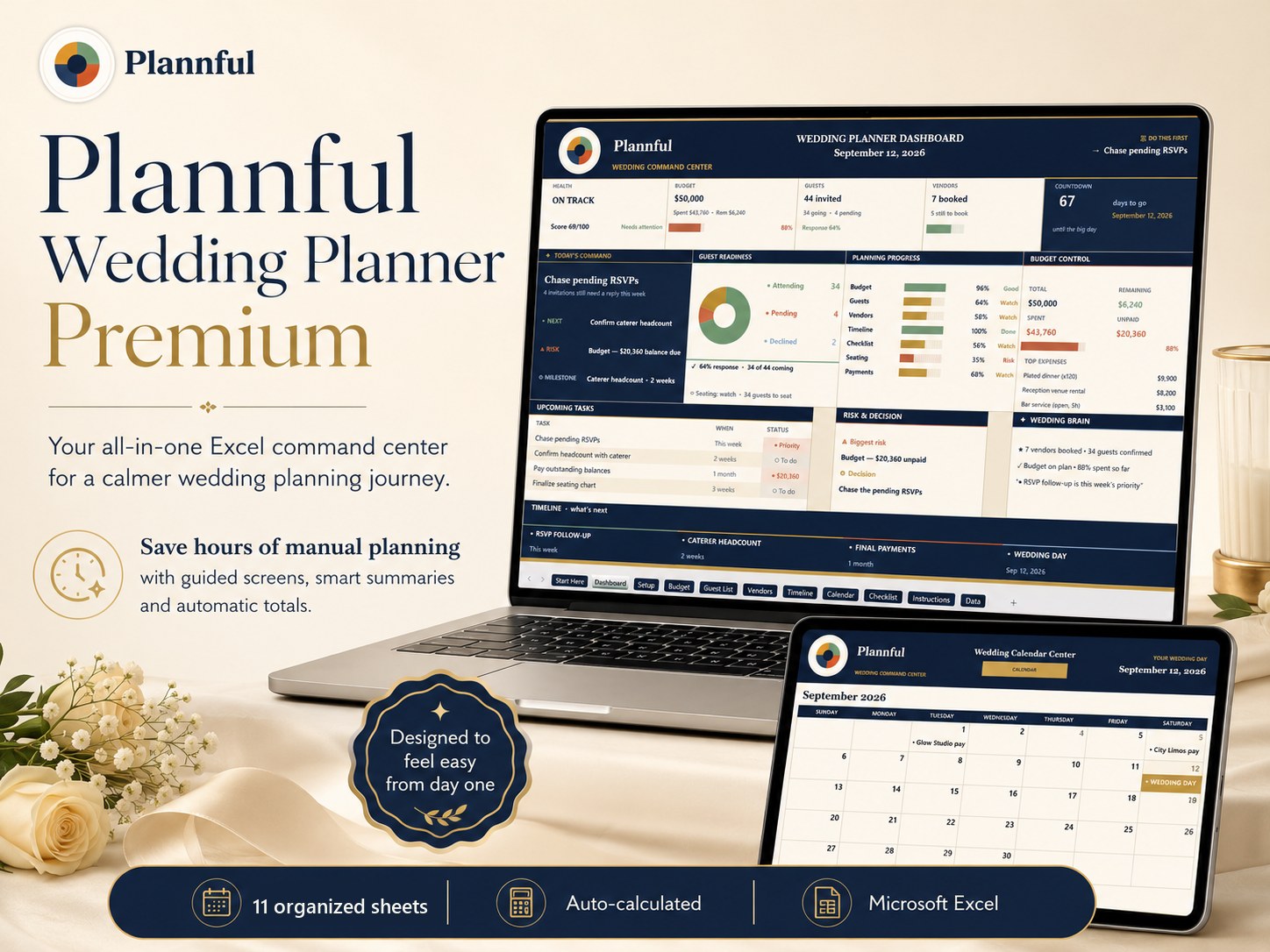
The Plannful Wedding Planner Premium for Microsoft Excel does the budget, guest list, timeline, calendar and checklist math for you — 10 organized working screens, real formulas, instant download.
See the Wedding Planner →Frequently asked questions
Is $50,000 enough for a wedding in 2026?
How much of a $50,000 budget should go to the venue?
How many guests can I invite with a $50,000 budget?
Do I really need a buffer in my wedding budget?
Planning your whole wedding?
Keep every part of your wedding — budget, guest list, vendors and timeline — organized in one Microsoft Excel workbook.
Plannful Wedding Planner for Microsoft Excel
- Budget Tracker
- Guest List
- Vendor Tracker
- Wedding Timeline
- Planning Calendar
- Checklist
Related guides & free tools
- How to Plan a Wedding on a $15,000 Budget in 2026Plan a beautiful $15,000 wedding in 2026: a full category breakdown for 50–75 guests
- Wedding Day Timeline: A Sample Hour-by-Hour Schedule for 2026Plan the perfect day with our hour-by-hour wedding day timeline for 2026. Get a ready-to-c
- Questions to Ask Wedding Vendors Before Booking in 2026The must-ask questions to ask wedding vendors in 2026, organized by type. Spot hidden fees
- How Much to Tip Wedding Vendors in 2026: The Complete Gratuity GuideThe headline rule for 2026: budget roughly 2−3% of your total wedding cost for tips.
- Wedding Budget for 100 Guests in 2026: The Real NumbersA 100-guest wedding in 2026 costs about $300 per guest, or roughly $30,000 total. See the
- How to Plan a Wedding Step by Step: The Complete 2026 GuidePlan your 2026 wedding step by step in 7 clear stages: set a budget, build a guest list, b
- Free Wedding Budget CalculatorFree tool · no signup
- Wedding Cost Estimator by Guest CountFree tool · no signup
Free cheat sheet
Get the 1-page wedding budget cheat sheet
Join the Plannful list for a simple breakdown of how to split your wedding budget by guest count — plus the occasional template discount. No spam, unsubscribe anytime.