Guide
How to Pay for a Wedding in 2026 Without Going Into Debt
The average U.S. wedding now costs around $33,000 in 2026, and most couples have 12 to 18 months to pay for it. The real challenge is not the price tag - it is paying without sliding into high-interest credit card debt that follows you into married life. With a plan, steady savings, and a few smart funding sources, you can fund a beautiful day in cash. Here is how, step by step.
Start with a number, then work backwards
You cannot build a savings plan without a target. Set a realistic total budget and divide it by the months until your wedding date - that gives you your required monthly savings, the most important figure in this process. If you have not nailed down your numbers, run them through our free wedding budget calculator for a category-by-category total in minutes.
Then subtract any money you already have saved and any confirmed family contributions. What remains, divided by your timeline, is your concrete monthly goal.
How much to save each month
Here is what the math looks like for a $30,000 wedding at common timelines. The longer your runway, the easier each month feels.
| Months until wedding | Monthly savings for a $30,000 wedding |
|---|---|
| 24 months | $1,250 |
| 18 months | $1,667 |
| 12 months | $2,500 |
| 6 months | $5,000 |
If those numbers feel steep, you have three levers: extend the timeline, lower the budget, or add funding sources - most couples pull all three. For a deeper breakdown, see our guide on how much to save per month for a wedding.
Open a dedicated wedding savings account
Do not let wedding money sit in your checking account where it blends in with rent and groceries. Open a separate high-yield savings account just for the wedding. In 2026, top online savings accounts pay around 4% APY, so a $20,000 balance earns roughly $800 a year while you save.
Set up an automatic transfer each payday so saving happens before you can spend - it is the single highest-impact habit for couples who hit their number.
Build a sinking fund for each category
A sinking fund means saving gradually for a known expense. Break your budget into category targets and fund each over time, so you do not overspend early and run short on essentials.
- Venue and catering - 45-50% of the total; fund this first.
- Photography and video - 10-12%; books up early.
- Attire, flowers, and decor - 15-18% combined.
- Music, rentals, and stationery - 10-15%.
- Buffer fund - 5-10% for surprises that appear.
Use family contributions and cash gifts wisely
Family money still covers a large share of weddings. Have the conversation early and get specifics: a fixed dollar amount is easier to plan around than a vague offer to help. To see how the traditional split works, read our guide on who pays for the wedding before the talk.
Cash gifts and a honeymoon fund can also offset costs, but most arrive after the wedding, so do not count on them for deposits. Many couples set up an online honeymoon registry so guests chip in toward the trip. Treat this as a bonus, not a core line item.
Avoid credit card debt - and weigh a wedding loan carefully
The fastest way to start married life under stress is to carry a credit card balance at 22% or more interest. If you use a card for points, pay it off in full the same month. Never finance a one-day event at revolving-credit rates.
A personal wedding loan is a more structured option, but it has trade-offs:
- Pro: a fixed monthly payment and clear payoff date, usually at a lower rate than credit cards.
- Pro: lets you lock in vendors now if prices are rising.
- Con: you start marriage in debt, with interest that can add thousands to the true cost.
- Con: 2026 personal loan rates often run 11-20% APR depending on credit.
For most couples, borrowing is rarely the smart move. Stretching the timeline and trimming the guest list almost always beats taking on a loan.
To pull it together: set your number, automate a transfer into a dedicated high-yield account, fund each category as a sinking fund, layer in family help and cash gifts, and refuse to carry debt. Our Plannful wedding budget templates do exactly that - calculating your monthly savings target and tracking deposits by category from engagement to the big day.
Plan the whole wedding in one place
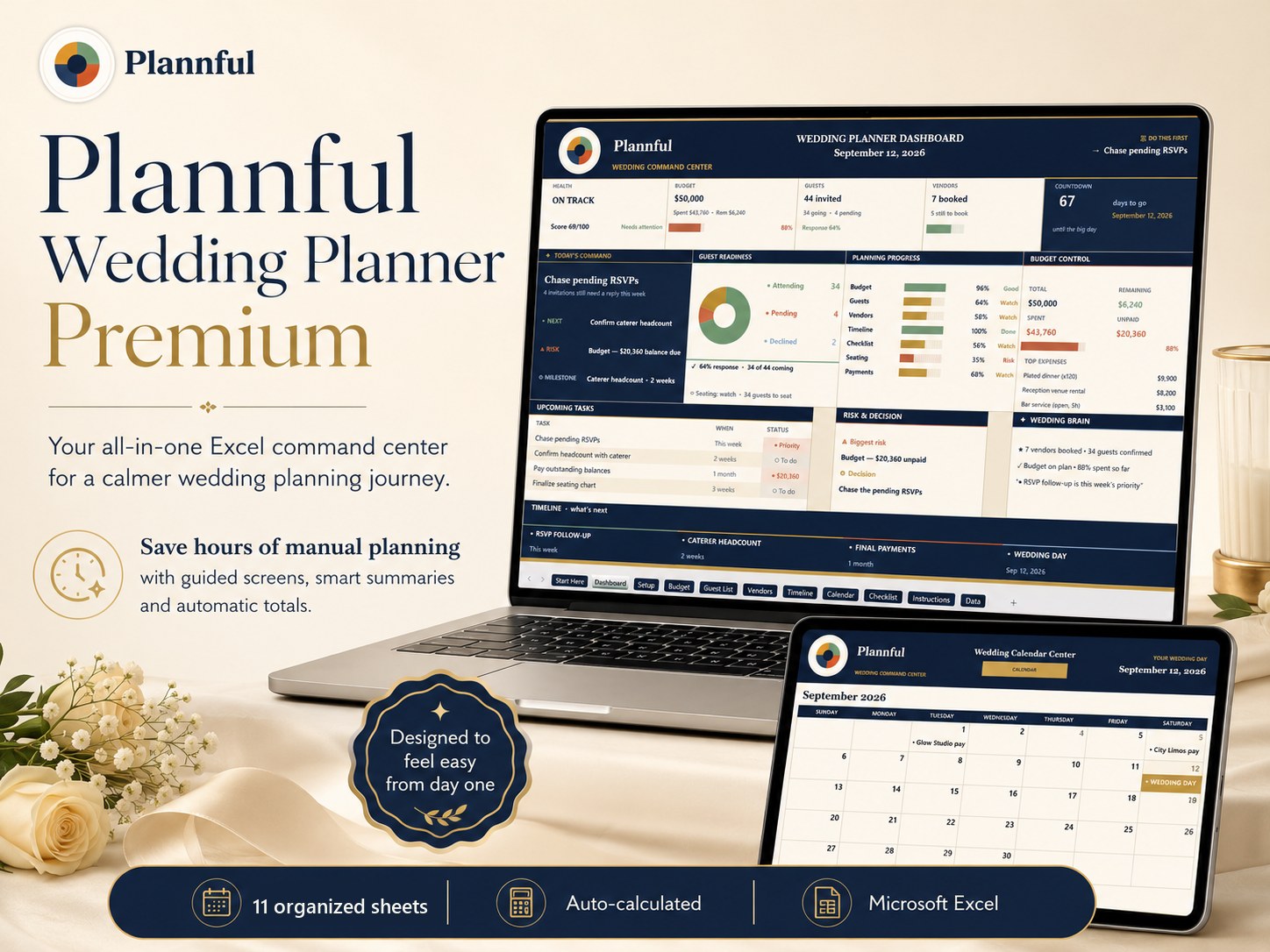
The Plannful Wedding Planner Premium for Microsoft Excel does the budget, guest list, timeline, calendar and checklist math for you — 10 organized working screens, real formulas, instant download.
See the Wedding Planner →Frequently asked questions
Is it smart to take out a loan for a wedding?
How much should I save monthly for a wedding?
What is a sinking fund for a wedding?
Should I open a separate account for wedding savings?
Planning your whole wedding?
Keep every part of your wedding — budget, guest list, vendors and timeline — organized in one Microsoft Excel workbook.
Plannful Wedding Planner for Microsoft Excel
- Budget Tracker
- Guest List
- Vendor Tracker
- Wedding Timeline
- Planning Calendar
- Checklist
Related guides & free tools
- How Much Does a Wedding Videographer Cost in 2026?How much does a wedding videographer cost in 2026? Most packages run $1,500-$4,500. See ti
- How Much Does a Wedding Cost in 2026? Full Budget BreakdownThe average US wedding costs about $34,000 in 2026. See a full cost breakdown by category,
- Wedding Budget Percentages: How to Split Your Budget (2026)Spend ~50% on venue and catering, 12% on photography, and keep a 5% buffer. See the full 2
- $20,000 Wedding Budget Breakdown (2026)A full $20,000 wedding budget breakdown for 2026 — category percentages, real dollar amoun
- Wedding Budget by Number of Guests (2026)How much a wedding costs by guest count in 2026 — budgets for 50, 100, 150 and 200 guests,
- Excel vs Google Sheets for Wedding Planning (2026)Excel vs Google Sheets for wedding planning in 2026 — offline vs sharing, cost, formulas a
- Free Wedding Budget CalculatorFree tool · no signup
- Wedding Cost Estimator by Guest CountFree tool · no signup
Free cheat sheet
Get the 1-page wedding budget cheat sheet
Join the Plannful list for a simple breakdown of how to split your wedding budget by guest count — plus the occasional template discount. No spam, unsubscribe anytime.