Guide
How to Save Money on a Wedding: 5 Big Levers for 2026
The average U.S. wedding in 2026 runs close to $35,000, but couples who plan with intention routinely spend $15,000 or less without the day feeling cheap. The trick is to pull the biggest levers first instead of clipping coupons on napkins. Below are the five highest-impact moves, ranked by how much real money they save, so you can build a budget that actually holds. Track every figure in our wedding budget spreadsheet templates and you will see the savings compound line by line.
1. Trim the guest list (cut 10 = save ~$2,900)
Per-head cost is the single most powerful number in your budget. With catering, bar, rentals, favors, and a slice of fixed costs spread across each seat, the all-in cost per guest in 2026 averages $290. Cut 10 names and you save roughly $2,900 instantly — before you negotiate a single vendor. Drop from 150 to 100 guests and you can shave $14,000 or more. Be honest about who truly belongs in the room: the coworkers you rarely see, the plus-ones you have never met, and the distant relatives invited out of obligation are the fastest names to cut. Remember a smaller list also shrinks invitations, transport, seating, and thank-you gifts, so the savings ripple far beyond the dinner plate.
2. Pick an off-season or weekday date (save 20-30%)
Venues and vendors price by demand. A Saturday in June 2026 carries peak rates, while a Friday, Sunday, or any date from November to March often unlocks 20-30% off the same package. On a $20,000 spend that is $4,000-$6,000 back in your pocket. Many vendors also throw in upgrades during slow months to win the booking. Ask each one directly for their off-peak rate sheet; many never advertise it, and a single email can save you thousands.
3. Rethink the bar
An open premium bar can add $45-$70 per guest. Switching to beer, wine, and one signature cocktail typically costs $18-$25 per guest, and a limited two-hour bar or a dry brunch reception saves even more. For 100 guests, that swap alone is worth $2,000-$4,500. If your venue allows it, buying your own alcohol and paying a flat bartending fee can cut the bar bill in half again.
4. DIY where it actually counts
DIY saves money only on items guests will not scrutinize: invitations, signage, favors, centerpieces, and a playlist instead of a DJ. Expect to save $1,500-$3,000. Do not DIY catering, photography, or anything safety-related — the stress and risk outweigh the savings, and a botched meal or lost photos cost far more than you saved. Run every DIY idea through our free wedding budget calculator first to confirm it truly pays off after you price your time and materials.
5. Choose a non-traditional venue
Dedicated wedding venues bake in a premium. A public park, family backyard, restaurant back room, art gallery, or Airbnb estate can cut the venue line by 40-60%. A traditional venue averaging $12,000 might drop to $4,500-$7,000, though budget a little back for rentals, insurance, and permits. The best non-traditional spaces often come with built-in charm, so you spend far less on decor too.
Savings at a glance
| Money lever | Typical 2026 savings |
|---|---|
| Cut 10 guests | ~$2,900 |
| Off-season & weekday date | 20-30% (−$4,000 to −$6,000) |
| Beer, wine & one signature cocktail | $2,000-$4,500 |
| Smart DIY (invites, decor, favors) | $1,500-$3,000 |
| Non-traditional venue | 40-60% (−$4,500 to −$7,500) |
Put it all together
Stack the top three levers and a $35,000 wedding can land near $18,000 without anyone noticing a downgrade. The couples who hit their number share one habit: they assign every dollar a job before booking anything, then update the plan after each deposit. A simple budget tracker turns vague hope into a running balance you can trust.
- Set your total cap first, then back into the guest count it allows.
- Lock the date and venue before any other vendor — they drive every downstream cost.
- Reserve a 10% contingency for the surprises that always appear.
- Review the spreadsheet weekly so overspending shows up early, not at the end.
Ready to start? Grab a ready-made planner from our Etsy shop, plug in your numbers, and watch each lever above turn into real dollars saved across 2026.
Plan the whole wedding in one place
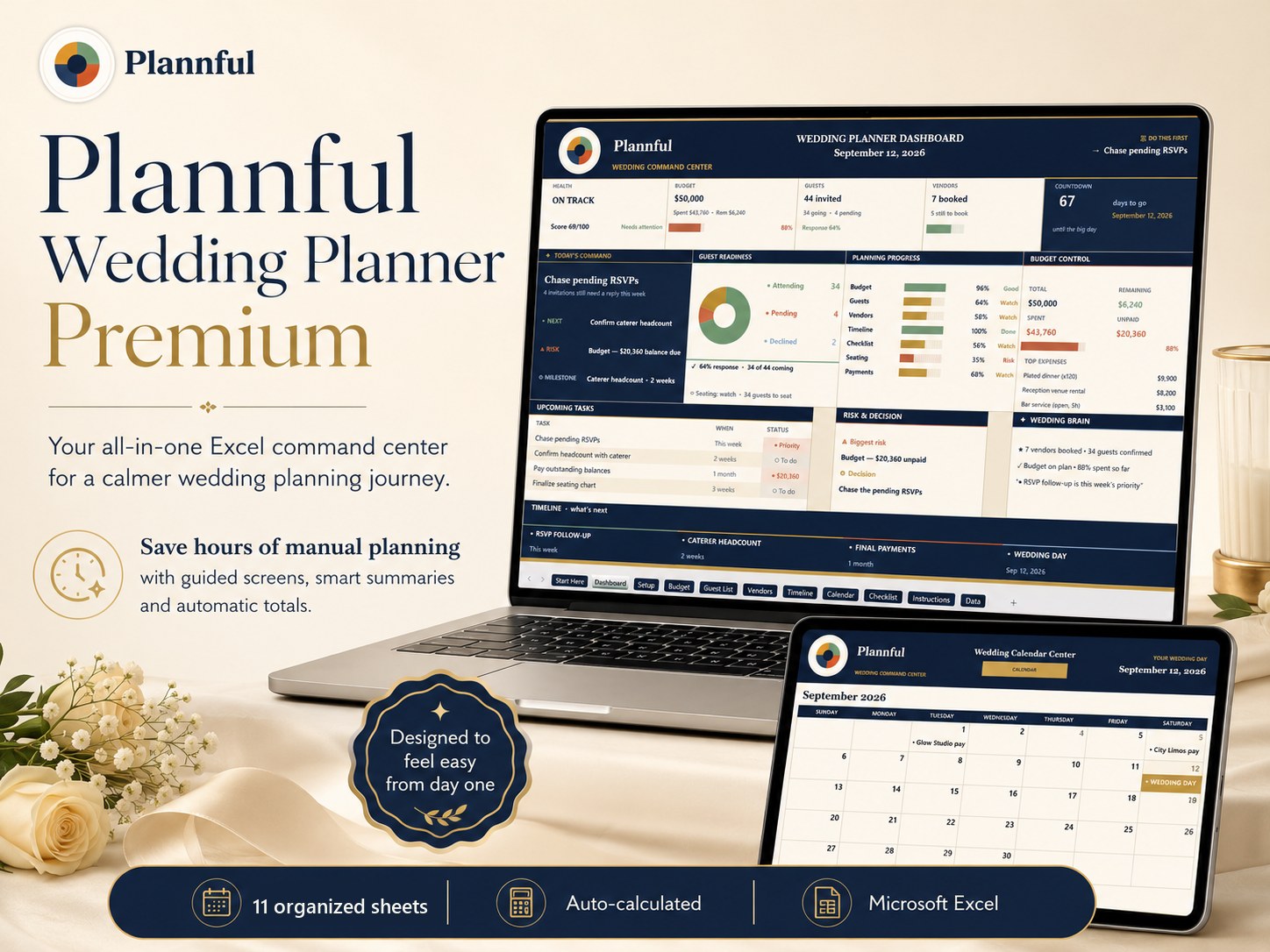
The Plannful Wedding Planner Premium for Microsoft Excel does the budget, guest list, timeline, calendar and checklist math for you — 10 organized working screens, real formulas, instant download.
See the Wedding Planner →Frequently asked questions
How much does the average wedding cost in 2026?
What saves the most money on a wedding?
How much can an off-season date save?
Is a cash or limited bar really cheaper?
Planning your whole wedding?
Keep every part of your wedding — budget, guest list, vendors and timeline — organized in one Microsoft Excel workbook.
Plannful Wedding Planner for Microsoft Excel
- Budget Tracker
- Guest List
- Vendor Tracker
- Wedding Timeline
- Planning Calendar
- Checklist
Related guides & free tools
- Average Wedding Venue Cost in 2026: What to BudgetIn 2026 the average wedding venue costs $6,000-$12,000, about 30% of your budget and usual
- Wedding DJ Cost vs Live Band: What to Budget in 2026Wedding DJ cost in 2026 averages $1,000-$2,500, while a live band runs $3,000-$7,000+. Com
- How Far in Advance to Plan a Wedding: The 2026 TimelineMost couples plan a wedding 12-18 months ahead. See the full 2026 timeline, when to book y
- Wedding Invitation Cost in 2026: What 100 Invites Really RunWedding invitation cost in 2026 runs roughly $400-$1,000 for 100 invites, about $4-$12 per
- Backyard Wedding Cost in 2026: What You'll Really SpendBackyard weddings average $10,000-$25,000 in 2026. See the 8 hidden rental costs (tents, r
- How Much to Save Per Month for a Wedding in 2026How much to save per month for a wedding in 2026? For a $30,000 budget over 18 months, set
- Free Wedding Budget CalculatorFree tool · no signup
- Wedding Cost Estimator by Guest CountFree tool · no signup
Free cheat sheet
Get the 1-page wedding budget cheat sheet
Join the Plannful list for a simple breakdown of how to split your wedding budget by guest count — plus the occasional template discount. No spam, unsubscribe anytime.